Home Grown by Enesco and Porcelain Figurines: A Cost Controller's Answer to What Makes a Good Personalized Corporate Gift
-
The Corporate Gift Rule I Had Backwards
-
Quality Is the Message
-
What Makes a Good Personalized Gift? It Has to Be Kept, Not Just Customized
-
The Real Cost of a Cheap Gift
-
The Budget Objection: What If You Can't Afford a $75 Gift?
-
How I Changed Our Procurement Policy
-
The Bottom Line: What Makes a Good Personalized Gift?
A good personalized gift is not about the personalization. It's about the object being worth keeping. I know that sounds like a strange line from someone whose job is to control costs, but I've changed my mind after seven years of buying corporate gifts.
I'm a procurement manager at a 340-person financial services company. I manage an $80,000 annual corporate gifting budget, I've negotiated with 60+ vendors, and I track every order in our cost system. My default answer to most requests is 'show me the total cost.' But the question 'what makes a good personalized gift?' has a different answer than I used to give.
Three things: the base product has to be worth keeping. The personalization has to fit the recipient. And the total cost has to make sense for the relationship you're trying to build. That's it.
The Corporate Gift Rule I Had Backwards
The conventional wisdom in corporate gifting is that personalization drives everything. Put the client's name on it. Put your logo on it. Make it custom. I believed that for years. Then I audited our spending and realized the items people actually remembered were not the ones with the biggest imprint.
Everything I'd read about personalized gifts said the thoughtfulness is in the custom details. In practice, I found the opposite: if the object feels cheap, the personalization feels like an apology. A name on a plastic gadget is still a plastic gadget.
In Q2 2023, I made this mistake the hard way. My production lead asked me to use an Enesco porcelain figurine from the Home Grown by Enesco collection for a large client appreciation order. I thought we could save 20% by going with a generic supplier. The boxes arrived with chipped bases, uneven glaze, and one figurine that looked like it had been repaired in a hurry. We had to reorder from Enesco anyway, and the 'savings' turned into a 30% premium plus an awkward apology call (that call is still on my list of things to forget).
I still kick myself for that. They warned me. I didn't listen. That's the costliest combination in procurement.
Quality Is the Message
Why would a cost controller argue for porcelain figurines over cheaper alternatives? Because a corporate gift is not inventory. It is a physical representation of how much you value a relationship. When a gift feels flimsy, the message is 'we didn't care enough to send something better.'
According to Enesco's own company history, the company has been in the gift industry since 1958. That matters less as a badge of age than as a signal of staying power. A company that has survived that long in the gift industry has a set of design standards. The Enesco catalog covers porcelain figurines, snow globes, nativity sets, crystal gifts, and home fragrance. These are not giveaway items. They are keepsakes.
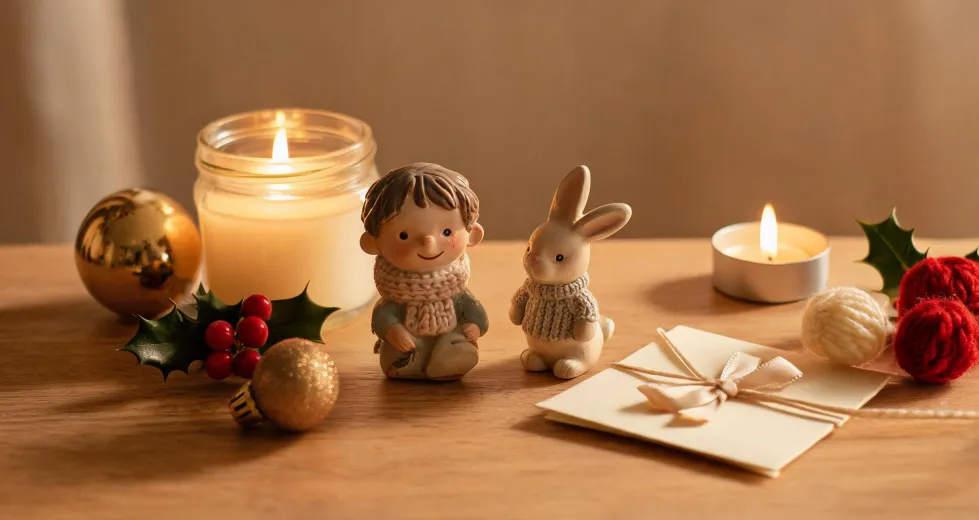
The Home Grown by Enesco line is a good example. The pieces have a hand-finished quality. You can see it in the faces, in the glaze, in the way a porcelain figurine feels heavy enough to be real. I am not romanticizing this. I have rejected enough poor-quality resin to know the difference.
A porcelain figurine with a good glaze does not just sit on a shelf. It becomes part of the room. And that is the point.
What Makes a Good Personalized Gift? It Has to Be Kept, Not Just Customized
Personalization is a multiplier, not the base value. A $20 item with a $5 engraving is a $25 item with a small chance of being kept. A $75 item with a $10 plaque is a keepsake that happens to carry your company's name. Different outcome? Yes.
Enesco's licensed lines also make the personalization easier. Instead of simply stamping someone's initials, you can choose a design that fits the recipient. A client who mentions her grandkids every call gets a Home Grown by Enesco family scene. A Disney fan gets an Enesco Disney porcelain figurine. That kind of selection is more personal than any logo I could print on a mug.
Personalization should answer 'why this person?' not just 'why our company?' A porcelain figurine with a name can feel like a label. A porcelain figurine that matches someone's interests, values, or memories feels like an invitation to keep it. That is the difference I look for now.
The best corporate gift I have ever sent was a personalized porcelain ornament with a small engraved date. It was not the most expensive gift in our budget, but it is still on the recipient's tree because it was a thing worth keeping. That is the test.
The Real Cost of a Cheap Gift
Now let's talk about money, because that is my job. Let's say an Enesco porcelain figurine costs $75, and a small engraved plaque brings it to $85. If it stays on a client's desk for five years, that is $17 per year of continuous brand presence. A $25 personalized mug that ends up in a drawer costs $25 and produces zero impressions after week two.
The denominator matters more than the numerator. I calculate the total cost of a gift as the gift cost plus labor, packaging, and shipping, divided by the number of years the recipient actually keeps it. That formula has changed the way I buy.
The most expensive gift is the one that isn't kept.
I'm not going to quote exact prices because retail prices change. Check the current Enesco catalog before you approve anything. But the price is not the real issue. The real issue is whether the line item creates a memory or just gets tossed. A gift that is not kept is not a gift; it's a cost.
The Budget Objection: What If You Can't Afford a $75 Gift?
I can hear the finance side of me saying: not every client gets a $75 gift. Fair. There are 200 customers and one budget. My answer is simple: do not water down the gesture.
If your budget is $15 per person, buy a smaller item from a brand that makes keepsakes. Or send a meaningful gift to your top 50 relationships and a printed card to the rest. Do not buy five forgettable promotional products for the same money you would spend on one thing someone actually keeps.
And do not confuse a trade-show giveaway with a personalized gift. A pen with your logo is fine when the goal is tabletop visibility. It is not a relationship gift. The difference is whether the recipient would display it or hide it.
I am not saying every gift has to be expensive. I am saying every gift has to be worth keeping. Those are different statements.
How I Changed Our Procurement Policy
After the chipped porcelain incident, I added a rule to our cost tracking system: any personalized gift over $30 requires an actual product sample before we approve the order. I built a cost calculator with one column for the premium option and one for the cheap-but-custom option. The premium option wins more often than I expected.
Why? Because the cheap option only looks cheaper on the invoice. When you add in the potential for a bad first impression, a reorder, or the quiet damage to a relationship, the real cost is higher. I would rather explain to a CFO why we spent $85 per gift than explain to a client why the gift arrived broken.
That decision came directly from experience, not from a textbook.
The Bottom Line: What Makes a Good Personalized Gift?
Here is my answer as the person who signs the POs: a good personalized gift is one that can survive the first five seconds. It is a gift the recipient is proud to display. It is an object with enough quality to carry the emotional weight of the gesture.
For me, Enesco—especially the Home Grown by Enesco line—has become the benchmark. I do not order a porcelain figurine because I like spending money. I order it because I have watched what happens when a kept gift carries a client's name for years. That is not a cost. That is a relationship investment.
I am still a cost controller. I still compare quotes. But I no longer ask, 'Which option is cheaper?' I ask, 'Which option will they still have in five years?' That question changes everything.

Elise Laurent
Elise Laurent is a crystal and decorative glass quality analyst covering crystal figurines, vases, ornaments, suncatchers, and gift glassware. She examines ISO 6486-1 where food-contact glass dinnerware applies, then uses polarized strain inspection, dimensional checks, surface-defect grading, and refractive clarity to compare decorative pieces outside that scope. Her work helps sourcing teams choose materials, finishing routes, and protective packaging without confusing visual brilliance with verified durability.
Start a gift conversation