Enesco Corporate Gifts FAQ: The Heart of Christmas, Harry Potter Figurines & More
-
1. Wait—what exactly is Enesco?
-
2. What is “Enesco The Heart of Christmas”?
-
3. Are Harry Potter Enesco figurines really a corporate gift?
-
4. Won’t a snow globe arrive as a pile of broken glass?
-
5. Is a tea set actually a good business gift?
-
6. Can I put my company logo on Enesco products?
-
7. How do I outsource promotional products order entry without losing control?
-
8. What’s the one mistake you won’t repeat?
If ordering corporate gifts is your job—or one of the many “other duties as assigned”—you’ve probably seen Enesco on an invoice and wondered what you actually just bought.
I’m the office administrator for a 90-person financial advisory firm. I manage roughly $80,000 a year in client gifts, holiday presents, conference giveaways, and internal recognition items. Five years into this role, I’ve learned the Enesco catalog the hard way: by ordering it, shipping it, and occasionally apologizing for it.
Here are the questions my colleagues ask every season. The last one is the question they should have asked two years ago.
1. Wait—what exactly is Enesco?
Enesco is one of those gift companies that’s been around long enough to feel like old news, but isn’t. It designs and distributes collectible figurines, ornaments, snow globes, nativity sets, home fragrance, crystal gifts, and several licensed lines—Disney and Harry Potter among them.
The outdated assumption is that Enesco is a Christmas-only brand. That thinking comes from an era when the company’s products appeared mainly in holiday sections of gift shops. Today the range is much wider. But the Christmas side is still strong enough to have its own name, and it’s usually the first thing corporate buyers discover.
2. What is “Enesco The Heart of Christmas”?
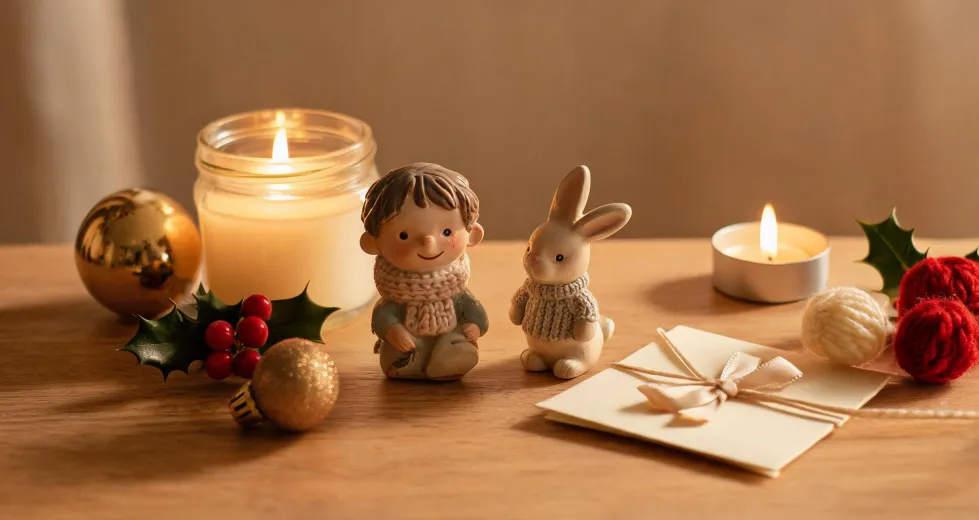
If you’ve searched for Enesco The Heart of Christmas because a client asked for “that ornament” or a specific nativity set, you’re not alone. It’s the name Enesco uses for its Christmas-focused collection—the classic side of the brand, with ornaments, figurines, snow globes, and other holiday décor.
Why should a corporate buyer care? Because it’s a coordinated program, not a random shelf of Santas. When I order from one collection, the pieces share the same design language. The boxes match. The finishes match. The gift feels intentional. For a company sending gifts to 200 clients, that consistency is half the value.
3. Are Harry Potter Enesco figurines really a corporate gift?
They sound like something you buy for your niece, not for a client’s CFO. But I’ve seen Harry Potter Enesco figurines generate more genuine enthusiasm than any branded tumbler we’ve ever shipped.
Two things make them work. First, they’re officially licensed, so the provenance is clean—no knockoff risk. Second, nostalgia is a powerful gift emotion. A senior partner at our firm sent one to a client who collects Potter memorabilia. Three weeks later, that client mentioned it to another partner. That’s what a gift is supposed to do.
My only caution: licensed gifts work best when you know the recipient. Save them for named clients rather than mass conference swag.
4. Won’t a snow globe arrive as a pile of broken glass?
Sometimes. I won’t pretend otherwise. A snow globe is glass, water, and glitter—fragile freight by definition. But the risk is manageable if you plan for it.
Here’s something vendors won’t tell you: the manufacturer’s wholesale carton does most of the protecting. If you order in quantity, keep items in that packaging until final shipment. I also order a small buffer—three extra globes per hundred—because a replacement from the distributor costs more than ordering it upfront.
Are snow globes worth the hassle? Yes, when the alternative is another branded mug. People keep snow globes on desks. They shake them. They tell coworkers where they got it. A pen can’t do that.
5. Is a tea set actually a good business gift?
I know “tea set” sounds like a wedding registry item, but it’s become one of our most reliable client gifts. There’s something about a tea set—the box, the ritual, the deliberate slowness of it—that reads as personal without being intimate.
Enesco’s wider catalog includes tea-related and teapot-themed pieces that fit neatly into corporate gifting. They come boxed. They don’t require sizing. They don’t expire. And they photograph well, which matters when a client posts a thank-you note on LinkedIn.
One of my favorite moments in this job was a photo from a client’s wife: their granddaughter having a pretend tea party with the porcelain set we’d sent. I can’t measure that return in the CRM.
6. Can I put my company logo on Enesco products?
Yes, but make sure you and your marketing team agree on what “logo” means. Enesco products often come through distributors who arrange personalization like engraving or printing. The limiting factor is the product itself—a flat base engraves better than a curved figurine.
Real talk on artwork: an image pulled from your website is usually not enough. A printed logo should be set up as vector art. If you need to match a specific corporate color, ask your distributor for a Pantone match instead of approving from a screen. And if a printer asks for a logo file and you hand over a small JPG, expect pixelation. That’s not the printer’s fault.
7. How do I outsource promotional products order entry without losing control?
This is the question nobody asks me, and it’s the one that would have saved me the worst November of my career.
Two years ago, I sat in front of a spreadsheet with 400+ holiday gift orders, typing the same SKUs into a distributor portal until my eyes crossed. I made mistakes. Clients got duplicates. An executive received a gift meant for a different account. I was the bottleneck, and I didn’t want to admit it.
If you’re asking how to outsource promotional products order entry and still sleep at night, here’s what worked for me:
- Start small. Outsource one product line for one season while you keep entering the rest.
- Document exceptions first. A good data-entry partner will ask: what happens when a SKU comes back invalid or an address doesn’t match the order? Decide this before peak season, not during it.
- Verify their invoicing. A vendor who can’t produce a clean invoice costs more in rejected expense reports than they save in labor. I learned that the expensive way.
- Keep decisions in-house. Outsource the typing, not the judgment. You still approve what gets ordered and who gets it.
Five years ago, this setup felt risky because outsourcing meant handing over your whole client list and hoping. Now, with portals and signed agreements, you can control access, track changes, and audit everything. The fundamentals—vet the vendor, define the process—haven’t changed. The execution has.
The numbers said outsourcing would save me twenty hours a week in December. My gut said handing over client names felt dangerous. Turns out the data was right, and my gut was just tired. A well-vetted partner with a signed NDA and an error process is less risky than a burned-out administrator transposing ZIP codes at midnight.
8. What’s the one mistake you won’t repeat?
Almost ordering unlicensed product. A supplier approached us with custom holiday ornaments at a price 40% below the official channel. The photos looked perfect—too perfect, actually, because they used characters from a certain famous movie franchise. When I asked for proof of licensing, the answer was a vague “our factory has arrangements.”
No factory has that arrangement. Licensed products like the Disney and Harry Potter lines go through authorized distributors for a reason. That discount wasn’t a deal; it was a liability.
If there’s one thing I want another admin to take from this: when the price is suspiciously low on an item with a character on it, the product is probably not the only thing being counterfeited. Walk away.
That’s my Enesco FAQ. If corporate gifting just landed in your job description, I hope this saves you at least one expensive lesson.

Elise Laurent
Elise Laurent is a crystal and decorative glass quality analyst covering crystal figurines, vases, ornaments, suncatchers, and gift glassware. She examines ISO 6486-1 where food-contact glass dinnerware applies, then uses polarized strain inspection, dimensional checks, surface-defect grading, and refractive clarity to compare decorative pieces outside that scope. Her work helps sourcing teams choose materials, finishing routes, and protective packaging without confusing visual brilliance with verified durability.
Start a gift conversation