500 Enesco Collectibles, One Corporate Gift Disaster, and the Packaging Lesson I'll Never Forget
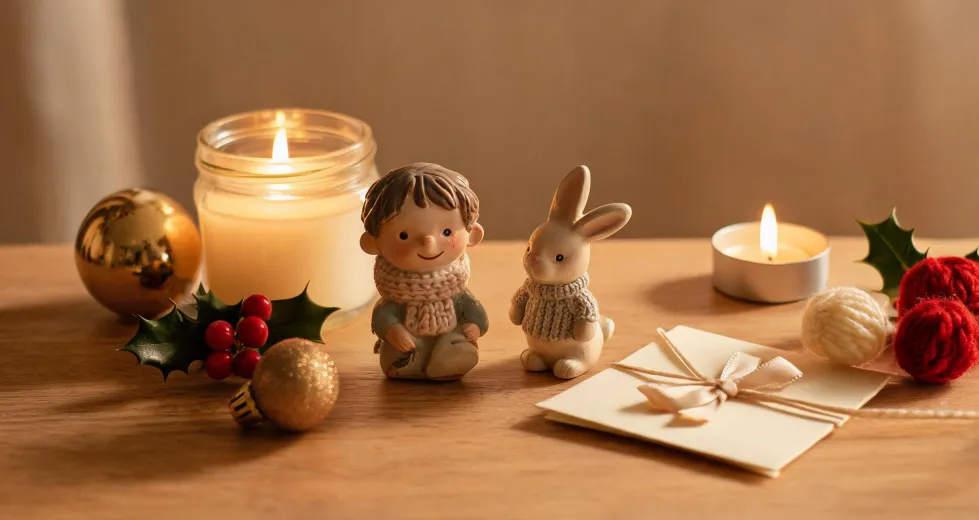
November 2019. I was standing in a conference room at 8 p.m., surrounded by 500 open boxes of Enesco collectibles. Enesco calico kittens figurines lined one table, angel figurine boxes were stacked against the wall, and one cup from the tea set had escaped its packaging and rolled under the radiator. The delivery van was due in 11 hours. (I know this sounds like the opening of a bad movie. It was.)
I've been handling corporate gift orders for about seven years now. In that time, I've personally made—and documented—five significant mistakes totaling roughly $41,000 in wasted budget. This was the first one, and it's the reason I still keep a pre-shipment checklist that our team runs before every seasonal order.
How It Began
Back in late September 2019, I was a marketing coordinator at a regional insurance brokerage. The marketing department was, for practical purposes, two people. My VP dropped a stack of client lists on my desk and said, “Make us look thoughtful this year.” I took that seriously. Maybe too seriously.
I thought a corporate gift program was simple: pick a product, buy in bulk, add a logo, send it out. I wanted something with warmth, so I started looking at Enesco collectibles. The distributor page had everything—Enesco calico kittens figurines, angel figurine gifts, crystal items, and a beautiful tea set with a floral pattern. I decided on 300 calico kittens figurines for our smaller client accounts, 120 angel figurines for clients who'd had a rough year, and 80 pieces of the tea set for our office open house. That's about 500 pieces.
I did not order product samples first. I want to say I negotiated a good price, but don't quote me on that. I compared two quotes, picked the lower unit cost, added 10 percent for unforeseen expenses, and sent the PO.
The First Red Flag I Missed
The first clue came when the distributor asked, “Are you aware these are licensed products?” I said yes. I wasn't. I thought “licensed” just meant the design belongs to someone. I didn't understand that the license controls how the product can be marketed, packaged, and even displayed at a corporate event.
Licensed merchandise is a bigger deal than most buyers realize. According to the 2024 Global Licensing Industry Study by Licensing International, licensed consumer product sales in the U.S. and Canada reached $156 billion in 2023. That includes gifts, ornaments, collectibles, and promotional products. The scale is exactly why rights holders enforce the rules so carefully.
Our logo is the perfect example. I wanted to print it on the outer carton of the Enesco collectibles. The licensing approval said no—the logo could only go on a belly band that didn't obscure the licensed artwork. That small change cost us six working days. The band had to be designed, printed, and approved all over again.
The Repacking Problem No One Warned Me About
Fast-forward to delivery. The merchandise arrived on time, which made me feel good for about four hours. Then I opened the first carton.
The Enesco calico kittens figurines were perfect. Honestly, they were cuter in person. But the angel figurines had a broken wing or a chipped base in 12 of the first 30 boxes. I told myself it was transit damage. It wasn't. My repacking plan had them upside down.
The tea set was another failure. The original retail packaging was fine, but I planned to remove the outer tray and slip the pieces into custom branded boxes. The result? Ceramic moving around in a small box with bubble wrap and hope. That's not a packing strategy.
From the outside, a bulk order looks like one transaction. The reality is that every unit has to be received, inspected, wrapped, repacked, sealed, labeled, and scheduled. I had not budgeted for any of that. Most buyers focus on per-unit pricing and completely miss the labor that happens after the carton arrives. I saved a little on the unit price and then spent way more fixing the outcome.
We turned the conference room into a repacking line. I want to say it cost about $4.50 per unit in labor, but that's because three of us stayed until 1 a.m. for two nights. Put another way: the discount I negotiated was smaller than the cost of cleaning up my own packaging plan.
The Dragon Ball Request That Made Me Get Honest
In the middle of the chaos, a sales colleague came in holding his phone. “Can we get a figurine Dragon Ball Broly vs Goku for this account?” It was for a client who ran a pop culture convention. I remember looking at the image on his screen and wanting to say yes.
I didn't. I checked with our Enesco distributor first. The answer was no—that particular anime license wasn't in the product lines available to us. Licensing terms vary by product and territory, and I had already learned not to assume. A promising client account was not worth a promise we couldn't back up.
When I compared the licensed quote structure for our Enesco collectibles with a non-licensed gift quote, I finally understood. Royalty, approval chains, packaging requirements, and territory rights all get baked into the cost. Seeing them side by side made me realize why details matter. It also made me appreciate the people who do this work daily—because it's not just putting figurines in boxes.
What the Shipment Taught Me
We shipped everything, eventually. Actually, let me be precise: we shipped three hours late, which in corporate gifting feels like missing Christmas. A few angel figurines were too damaged to send, and we replaced them with backstock. No client ever knew. That's the part that still bothers me: it looked fine from the outside, but underneath it was a series of avoidable mistakes.
Even after the final van left, I kept second-guessing. What if the logo placement was wrong? What if the tea set arrived cracked? I didn't relax until the first delivery confirmation appeared. (Confirmation emails are an underrated pleasure.)
The other thing that changed was my attitude toward small orders. At the time, I assumed a $200 sample order wasn't worth a vendor's time. Then a supplier sent me a fully finished sample order of 50 units with branded packaging for less than $300. That supplier now handles our Q4 program. Small doesn't mean unimportant—it means potential.
The Checklist I Still Use
If you're ordering branded Enesco collectibles, or any licensed gifts, here's the short version of what I now check before every order:
- Order a finished sample first. Not just the figurine—the entire packaged gift, including the logo, insert, and outer box, if that's how it will be delivered.
- Build at least two extra weeks into the timeline for licensed product approvals. If the license doesn't allow something, it's better to find out in week two than week seven.
- Budget for every touch point: receiving, inspection, repackaging, labeling, and the occasional broken angel wing.
- Give a $200 order the same care as a $20,000 order. You never know which small client is about to become your biggest advocate.
I still order Enesco products today. The calico kittens figurines are still, to my relief, adorable. And yes, I still check the packaging before anyone slaps a label on it. The lesson wasn't that catalog gifts are risky. It was that the process matters just as much as the product—especially when the product is something people treasure.

Elise Laurent
Elise Laurent is a crystal and decorative glass quality analyst covering crystal figurines, vases, ornaments, suncatchers, and gift glassware. She examines ISO 6486-1 where food-contact glass dinnerware applies, then uses polarized strain inspection, dimensional checks, surface-defect grading, and refractive clarity to compare decorative pieces outside that scope. Her work helps sourcing teams choose materials, finishing routes, and protective packaging without confusing visual brilliance with verified durability.
Start a gift conversation